Market share no longer decides whether an AI assistant names your brand. In 28 of 40 food and drink categories the market leader is not the brand ChatGPT, Claude and Gemini show most, and in the US the retailers' own assistants have started selling space in and around their answers. AI visibility now has an earned side and a paid side, and brands need a plan for each, judged on share of answer by shopping occasion.
Key takeaways
- In 28 of 40 food and drink categories, the market leader is not the most visible brand in ChatGPT, Claude and Gemini answers (Tastewise via The Grocer, Aug 2026).
- AI-referred visits to US retail sites converted 90% better and earned 83% more revenue per visit than other traffic in September 2026 (Adobe), yet assistants send under 1% of retailers' linked traffic (Bain, Similarweb estimates).
- Sparky usage grew 129% year on year in the US in Walmart's Q3 FY27, and Walmart has tested sponsored prompts inside its assistant since January 2026.
Does AI visibility follow market share?
No. Two independent studies, one on retailers and one on brands, reach the same answer.
Bain & Company ran more than 4,400 shopping prompts through the main assistants for a study published on 21 November 2026. Its data partner is Profound, a commercial generative engine optimization (GEO) vendor, and the indexing method is not published. In US consumer electronics, Amazon holds 25% of the market but 12% of indexed AI visibility. In US home improvement, Lowe's holds 9% of the market and 26% of visibility, nearly three times its share. The study covers retailers in four US verticals, not brands.

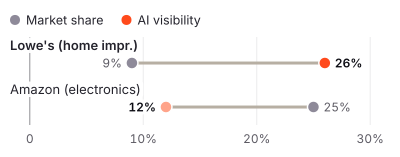
The brand evidence comes from Tastewise, a vendor that sells its own visibility tracker. In its analysis, reported by The Grocer in August 2026, the share leader did not make the assistants' top ten at all in nine of 40 categories. Both studies rest on vendor prompt data that moves with every model update. The direction is still firm enough to act on: share of market cannot stand in for share of answer.
How many shoppers use AI, and is the traffic worth it?
Bain's Consumer Lab puts the share of consumers using AI assistants somewhere in their shopping at nearly 33% in the US and 36% in Europe, against 19% and 8% in 2025 (Bain, 20 November 2026). It is one survey with no published sample or country list. Eurostat's official figure is 32.7% of EU-27 residents aged 16 to 74 using generative AI for any purpose in 2025, and 25.5% for private use (Eurostat). Bain's shopping figure is higher than Eurostat's share for any private use of generative AI, so treat it as indicative, not as a population measure.
In the US the number depends on the question. The NielsenIQ figure we cited at 51% on 25 October counts any AI-powered shopping tool, recommendations included; its cut for personal shopping assistants is 16% (NielsenIQ, September 2026). A sixth to a half, by definition.
Value is measured, in the US. Adobe's analytics on more than a trillion visits show AI-referred visits converting 90% better than other traffic in September 2026, from 9% worse in August 2025, with 83% more revenue per visit (Adobe Digital Insights). The base is thin: assistants bring under 1% of the web traffic that reaches retailers through direct links, on Bain's reading of Similarweb estimates.
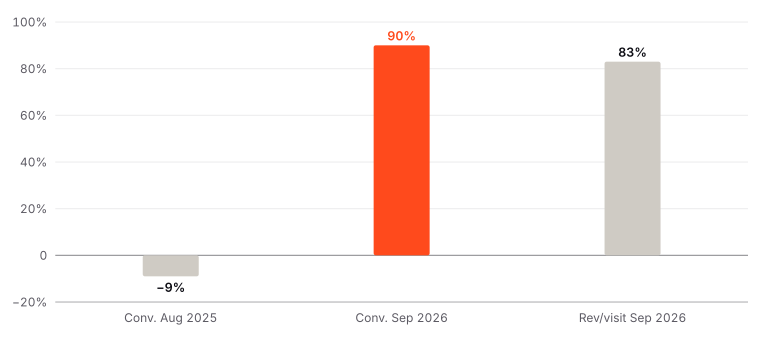
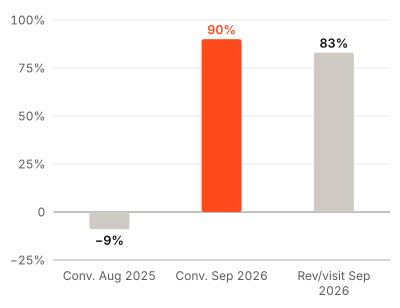
Few but valuable visits justify moving some money, not rebuilding the plan; Europe has no such measure yet.
Earned in third-party assistants, paid in retailers' own
Third-party assistants mostly cite sources brands do not own
In Bain's US grocery prompts, earned media is the top citation source for Claude (58%), Gemini (46%) and ChatGPT (30%), while retailer and brand websites, counted together, supply 16% of ChatGPT's citations and 13% of Gemini's. Google's AI answers lean on social platforms (29%) and search results (25%). A place in a ChatGPT or Claude answer is won mainly through coverage, reviews and complete retailer listings. Our 15 November piece covered the product record agents read; earned coverage is the reputation they weigh around it.
Retailer assistants are turning into paid shelf space
Walmart reported a 129% rise in US Sparky usage year on year for the quarter to 31 October 2026, without defining usage, and 36% growth at Walmart Connect excluding VIZIO and Vibe (Walmart Q3 FY27); our 5 November figure of 43% excluded VIZIO only, so the two are not like for like. Since January 2026 Walmart has tested sponsored prompts in Sparky's recommendations, limited to items it sells (Adweek). Amazon's sponsored prompts, which can open a Rufus conversation, became generally available to US advertisers on 25 March 2026 (Amazon Ads), and Amazon credits Rufus with nearly $12 billion in incremental annualized sales in 2025, a self-reported figure (Amazon). Bain's global Consumer Lab survey finds 21% of consumers trust retailers' own assistants against 12% for third-party ones.
| Assistant and evidence | Earned or paid |
|---|---|
| Third-party assistants (US grocery prompts): earned media is the top cited source for Claude, Gemini and ChatGPT | Mostly earned; Google AI leans on social and search |
| Walmart Sparky (US): sponsored prompts in test since Jan 2026; Sparky usage +129% y/y in Q3 FY27 | Paid, closed loop: Walmart-listed products only |
| Amazon (US): Sponsored Products and Brands prompts generally available to US advertisers since 25 Mar 2026 | Paid; prompts can open a Rufus dialog |
| ChatGPT and Google: brand ads below ChatGPT answers in the UK since Jun 2026; ads inside Google AI Overviews | Paid formats arriving: the split is not absolute |
| European retailer assistants: no paid format found in any source we read (Nov 2026) | Not seen yet: a watch item |
The split is not absolute: ChatGPT has shown brand ads to UK users since June 2026 and Google places ads in AI Overviews (The Grocer). And we found no paid format inside a European retailer's assistant in any source we read. In Europe the paid line is a watch item for 2027, not yet a budget.
Where should the money sit in 2027?
Motion & Gain's view: keep the single commercial owner we argued for in our 25 October piece, and run the money through two lines that live in different places.
- The earned line is central: coverage, reviews, expert content and retailer product pages that third-party assistants cite, funded from brand and communications budgets.
- The paid line is not a new budget: a sponsored prompt in Sparky or on Amazon is retail media, so it sits inside each retailer's single envelope and faces the incremental-profit test we set out for retail media and trade promotion. If it cannot beat a control group on incremental gross profit, the money goes to a line that can.
One measure joins the two. Share of answer is the share of an assistant's replies to real shopper prompts that name the brand; track it by occasion ("a quick dinner for four", "a lunchbox snack") beside share of market for that occasion. Occasion matters: Tastewise found that asking for better-for-you options changed the most visible brand in 30 of 40 categories.
In the Motion & Gain commercial value chain, this sits in Corridor 2, Boost Consumer Engagement Effectiveness: brand awareness (O8), a seamless purchase journey (O10) and conversion (O12).
What to do now
- Track share of answer by occasion (Head of Consumer Insight, 60 days): ten occasions per priority category and market, monthly, beside share of market.
- Map what the assistants cite (Brand and communications leads, 30 days): the 20 most cited sources per assistant in your prompts, then aim the earned budget at those you can influence.
- Put assistant placements inside the retailer envelope (Key account director, 90 days): in the US, buy prompts only with a holdout test in the plan; in Europe, ask each retailer with an assistant when paid formats arrive and how they will be measured.
- One owner, one scorecard (CCO, 30 days): so earned and paid spend are compared, not defended separately.
The bottom line
The brands assistants name are not simply the biggest, and retailers with their own assistants have started to sell placements around the answer. Fund the earned sources third-party assistants read, buy retailer placements only inside that retailer's profit test, and measure both by occasion before 2027 budgets close.
Questions leaders ask
What is share of answer in AI shopping?
Share of answer is the percentage of an AI assistant's replies to real shopper prompts that name a brand: the AI counterpart of share of market. The two diverge: in Bain & Company's November 2026 study, Lowe's had 26% indexed visibility against 9% market share in US home improvement. Measure it by occasion, market and assistant.
Should brands pay for ads inside retailers' AI assistants?
In the US, test them inside the retail media budget already agreed with that retailer. Walmart has tested sponsored prompts in Sparky since January 2026, and Amazon's prompts have been generally available to US advertisers since March 2026. Neither discloses results, so judge each placement on incremental gross profit against a holdout.
How many European shoppers use AI assistants?
No official statistic measures it. Bain's survey says 36% of European consumers in November 2026, without a published sample; Eurostat's 32.7% (EU-27, ages 16 to 74, 2025) covers any generative AI use, not shopping. Plan for a sizeable, fast-growing minority.