AI visibility is the share of AI-generated answers in which your brand is named when a shopper asks for a recommendation in your category. It is becoming the new shelf space, and in most companies nobody owns it. The brands that treat it as a commercial KPI, not an SEO side project, will set the shortlist everyone else has to break into.
Key takeaways
- 55% of consumers across 31 countries say AI recommendations at least sometimes shape their grocery and household purchases (NIQ, October 2026).
- In 53.7% of 1,094 US categories tracked in ChatGPT, no brand is consistently named, so the shortlist is still open (Semrush vendor study).
- Classic SEO strength barely predicts who wins: category owners had more organic traffic than the runner-up in only 48.4% of cases.
How many shoppers already let AI shape the shortlist?
Enough that it now belongs in the brand plan. NielsenIQ's Consumer Outlook: Guide to 2027, a survey of more than 21,000 consumers in 31 countries published on 7 October, found that 55% say AI recommendations at least sometimes influence their household and grocery purchases, and 27% actively used an AI tool or assistant to research or decide what to buy in the past three months.
The US readings run higher. NIQ's monthly tracker put the share of US consumers using at least one AI shopping tool in the past month at 51%, the first time it crossed half. McKinsey's ConsumerWise survey of February 2026 found that 68% of US consumers used an AI tool in the past three months, and that 19% of those users turned to it to discover or decide on brands, products or services.
AI and the shopper, at a glance
- 55% are influenced by AI recommendations at least sometimes (31 countries)
- 27% used an AI tool to research or decide a purchase in the past 3 months (31 countries)
- 51% used at least one AI shopping tool in the past month (US)
- 68% used any AI tool in the past 3 months (US)
- 19% of US AI users use it to discover or decide on brands
The definitions differ, but the direction does not. AI is now a step in the path to purchase for a large minority of shoppers, and for a majority in the US. Buyers have noticed: worldwide Google search interest in "AI visibility" was 74% higher in the last quarter than in the first quarter of the past 12 months, according to Google Trends (relative search interest, not volume), and autocomplete now offers "ai visibility score" and "ai visibility audit".
Is the AI shortlist already decided?
Not yet, and that is the opportunity. Semrush tracked brand mentions across 1,094 US categories in ChatGPT from January to June 2026. Its study, which is vendor research built on its own toolkit, classed a category as having a clear owner only if one brand was named in at least four of five prompts with a lead of five percentage points or more.

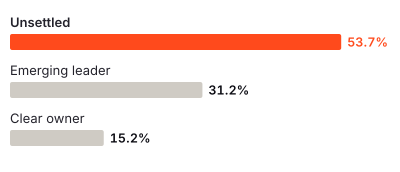
Only 15.2% of categories had a clear owner; 53.7% were unsettled, with no brand named in even three of five prompts. Once a brand owns a category, it tends to keep it: owners held first place in 90.4% of month-on-month comparisons. Where the leader flipped, its median lead had been 1.3 points, against 2.9 points where it held. The window to claim a category is open now, and it will not stay open.
Why doesn't strong SEO guarantee brand visibility in LLMs?
Because the answer engine is weighing different evidence. In the same Semrush data, the category owner beat the runner-up on branded search volume in only 55.7% of pairs, on organic traffic in 48.4% and on domain authority in 52.5%. That is close to a coin toss. Website visibility, the metric most marketing teams report, says little about whether an assistant will name you.
The stakes run both ways. A survey of 2,000 US AI users by Talker Research, commissioned by an agency that sells AI visibility services, found that 70% had discovered a brand for the first time through an AI recommendation, and 68% had ruled out a brand they were considering because of something AI told them. Treat the figures as directional, but the mechanism is clear: the assistant both adds brands to the shortlist and removes them.
How to read an AI visibility score. Most tools run a fixed set of category prompts through one or more assistants and count how often each brand is named, cited or recommended. Ask three questions of any score: which prompts, which assistants and markets, and whether it separates a passing mention from a recommendation.
Who should own AI visibility?
This is where most companies stall. Brand teams think it is SEO. Digital teams see a content problem. eCommerce sees it as a retailer issue. In our view, AI visibility belongs with brand equity, alongside salience and consideration, because that is what it measures: whether your brand comes to mind when the shopper delegates the remembering to a machine. It sits in the corridor we call Create Superior Product Portfolio & Brands, next to pricing power, and it feeds awareness and quality trial in consumer engagement.
The redesign is in the decision, not the tool. A brand that scores AI visibility monthly by category and market, and lets that score move content, claims and product-data budgets, will compound. A brand that buys a dashboard and files it under digital will not. We made the same argument for agent-led buying in Agents Can Now Buy. Have You Decided What to Sell Them?: the agent rewards the brand whose offer is legible to it.
What to do now
- Run an AI visibility audit of your top ten categories (CMO, 30 days): 20–30 real shopper prompts per category, in each priority market and language, across the assistants your shoppers use. Record named, cited and recommended separately.
- Put an AI visibility score in the brand-health tracker (Head of Consumer Insight, 60 days), reported next to salience and consideration, with a target per category.
- Fix the evidence the assistants read (eCommerce and Brand, 90 days): complete product data, specific claims with proof, consistent retailer listings and credible third-party reviews.
- Defend where you lead, attack where it is unsettled (Category Directors, 90 days): concentrate effort on the categories with no owner and on those where your lead is under three points.
- Name one accountable owner (CCO, 30 days), with a budget line, rather than splitting AI visibility across SEO, PR and eCommerce.
The bottom line
A majority of shoppers in many markets now let AI shape what they consider, and in more than half of categories the AI shortlist has no clear owner. That will not last. Treat AI visibility as brand equity, measure it monthly, and give it an owner before a competitor makes the category theirs.
Questions leaders ask
What is a good AI visibility score?
There is no universal benchmark yet. Use Semrush's owner threshold as a working bar: named in four of five category prompts, with a lead of five points or more over the next brand.
Is generative engine optimization just SEO with a new name?
It overlaps, but the evidence differs. In Semrush's data, organic traffic predicted the category owner in fewer than half of cases, so product data, claims and third-party proof matter more than rankings alone.