The Wegovy pill is now on sale in the UK, Germany, France, Spain, Poland and the UAE, and food and drink makers are being asked what it means for their 2027 plans. The honest answer from the US data: a mix reset, not a volume collapse. Re-cut packs and portfolio where exposure is high, size that exposure from your own market's panel, and leave the rest of the range alone.
Key takeaways
- US households with a GLP-1 user cut grocery spending by 5.3% within six months of adoption, and the cut shrinks over time (Journal of Marketing Research, 2023–24 data).
- The basket barely moves, single categories do: in year two, total retail alcohol sits 10.2 index points below its baseline and pork rinds 16.1 above (Circana, index points, not %).
- Only 6.3% of GB households had a current user in 2026 (Worldpanel by Numerator), so European plans built on US penetration of 30% (Circana, a different panel) would overstate exposure several times over.
What the US data says about GLP-1 and the grocery basket
The most cited number is also the most modest. In the peer-reviewed study by Hristakeva and Liaukonyte in the Journal of Marketing Research, US households cut grocery spending by 5.3% on average within six months of someone starting a GLP-1 medicine, based on a Numerator panel of about 150,000 households in 2023–24. PwC's own reading of Numerator data, reported by Reuters in February 2026, puts family baskets 4% to 6% smaller. Two analyses, one direction, roughly one size.
The effect also fades. The JMR authors found the reduction lasts at least a year but shrinks, and that about one in three users stopped during the study, after which their spending went back to where it was. Circana's newer work points the same way in a different unit. Its 10 November 2026 release tracks a consumption index of user against never-user households, and the retail food and beverage index sat 1.9 points below its pre-treatment baseline in year two, against 2.5 points in year one according to The Shelby Report. Circana is explicit that these are index points, not percentage changes in spending, and user households still outspend non-users. A planning team that reads the 5% as permanent and basket-wide will cut the wrong things.
Which food and drink categories actually move?
The averages hide the swing. Circana's subcategory figures, presented by its analysts in a webinar reported by The Shelby Report, show the losses and gains concentrating in a short list of aisles.
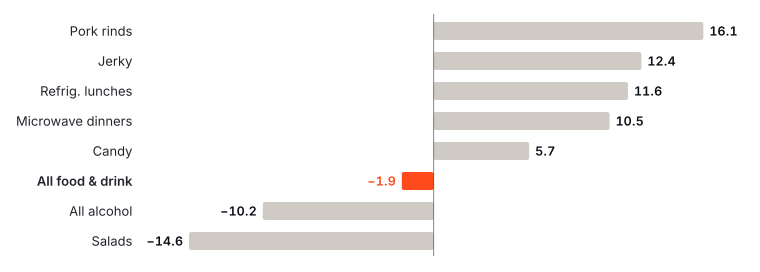
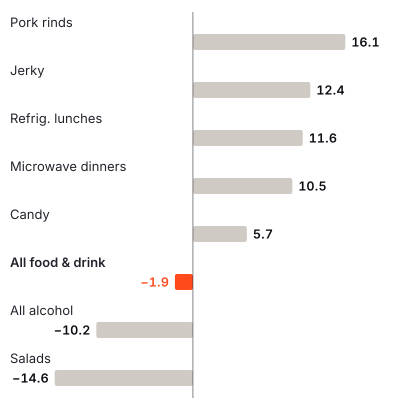
On the losing side in year two: total retail alcohol at 10.2 index points below baseline and salads at 14.6 below. The JMR study adds savory snacks, down about 10% in spending within six months. On the gaining side: pork rinds (+16.1), jerky (+12.4), refrigerated lunches (+11.6) and microwaveable dinners (+10.5), which is protein and portioned convenience. Treats are the surprise. Candy is 5.7 points and frozen desserts 5.3 points above baseline by year two, after the early dip the JMR data captured.
The breadth needs care. More subcategories gain in year 2 than in year 1 (81 to 117 of 301), which means most subcategories still did not gain. The story is concentration, not a rising tide, and the treat aisle is the clearest case for not overreacting to a first-year dip.
How big is the Wegovy pill's reach into Europe and the Gulf?
Novo Nordisk's Form 6-K of 4 November 2026 lists the Wegovy pill as launched in eight markets, among them the UK, Germany, France, Spain, Poland and the UAE, and expects it in more than 20 markets in 2027. That widens access. It does not tell a category director how many of their shoppers are affected, and only one European market has a household panel that does.
| Year | GB households, % |
|---|---|
| 2024 | 2.3% |
| 2025 | 4.1% |
| 2026 | 6.3% |
Worldpanel by Numerator found 6.3% of GB households with a current user in 2026, up from 2.3% in 2024, about two points a year. Circana's 2026 survey reports a current user in 30% of US households. The two come from different panels with different definitions, so they are not a like-for-like comparison, but the order of magnitude is the point: a European plan that borrows the US share imports an exposure Britain does not have yet.
For Germany, France, Spain, Poland and the UAE there is no published household panel figure. What follows is a Motion & Gain scenario, not data: multiply local penetration by the per-household cut. At GB's 6.3%, a 5.3% cut touches about 0.3% of total grocery spend; with savory snacks' 10%, about 0.6% of that category. At 15% penetration, the same arithmetic gives 0.8% and 1.5%. Small for a market. Material for a category P&L and its pack mix.
What food and drink makers are doing with packs and portfolio
Moves are visible, measured payoffs are not. PepsiCo's Q3 2026 remarks say its portion-control multipacks, above USD 3.5bn in annual net revenue, grew both volume and net revenue in the quarter, alongside protein and fiber extensions. Danone's Q3 release credits High Protein with driving its European dairy growth, including France, Spain and the UK. Neither company attributes these results to GLP-1.
The executives disagree on scale. At CAGNY in February 2026, General Mills' Jeff Harmening said the drugs "will have a lasting influence on the food market", while Mondelez's Dirk Van de Put called the volume effect "minimal", both as reported by Food Dive. Our recommendation below is therefore a Motion & Gain position built on adjacent evidence, not a proven GLP-1 return.
What to do now with 2027 category plans
In the Motion & Gain value chain, this is Corridor 1, Create Superior Product Portfolio & Brands: SKU productivity (O5), product mix (O6) and the innovation pipeline (O1).
- Size exposure from your own panel. Take local household penetration times the category's cut. Where that moves more than about 1% of category spend, or the category sits in the high-exposure set (alcohol, fresh salads, savory snacks, chocolate in GB), it earns a 2027 line.
- Re-cut the pack ladder in those categories only. Add a single-portion or multipack step at the bottom, and test whether the largest pack still earns its shelf space before you delist it.
- Move innovation towards formats that gain. Protein snacks and portioned prepared meals show the strongest year-two gains; that is where a pipeline slot pays.
- Hold the treat aisle steady. Candy and frozen desserts recovered above baseline; a year-one dip is not a reason to cut range.
- Skip the blanket relabel. A "GLP-1 friendly" sticker across the range changes no pack economics and dates fast.
The bottom line
The Wegovy pill makes the question urgent in Europe and the Gulf. The answer is narrower than the headlines. Pick the handful of categories where local exposure is real, rebuild their pack ladders and protein formats for 2027, and spend nothing on the rest. The cost of overreacting, cutting range in categories that recover, is larger than the cost of waiting a year for better local data there.
Questions leaders ask
Do GLP-1 users cut food spending permanently?
The US evidence says no. The Journal of Marketing Research study found a 5.3% cut within six months that persists for at least a year but shrinks, and spending returned to earlier levels among the roughly one-third who stopped. Circana's retail food and beverage index was 1.9 points below baseline in year two, against 2.5 in year one, and 48% of previous-user households said they were at least somewhat likely to restart within a year. Plan for a smaller, shifting effect, not a permanent step down.
Should European food makers use US GLP-1 penetration in their plans?
No. Circana reports a current user in 30% of US households; Worldpanel by Numerator reports 6.3% of GB households in 2026. They are different panels and definitions, so the gap is indicative, but it is wide. Outside Britain no household panel figure is published, so Germany, France, Spain, Poland and the UAE need a labelled scenario from local penetration estimates until local panels report.
Which categories should change their pack ladders for 2027?
Those with high exposure and a pack lever: alcohol, fresh salads and savory snacks in the US data, plus chocolate confectionery in GB, where Worldpanel saw users' spending fall 18 points more than non-users'. Portioned and protein formats are the gaining side. Treat categories such as candy and frozen desserts recovered by year two and should not cut range on first-year numbers.