The shelf is no longer decided by the brand's field visit. It is decided by the retailer's task queue. Most out-of-stocks start and get fixed inside the store, and large retailers increasingly route that store work through their own staff devices. A perfect store programme that still counts visits is measuring the wrong thing: a brand earns its availability by getting its gaps into the retailer's queue, and in the UK that queue is running with fewer hands every quarter.
Key takeaways
- 70-75% of out-of-stocks were caused at retail level, mainly store ordering (47%) and shelf management (25%), in the worldwide GMA/FMI/CIES study of 2002.
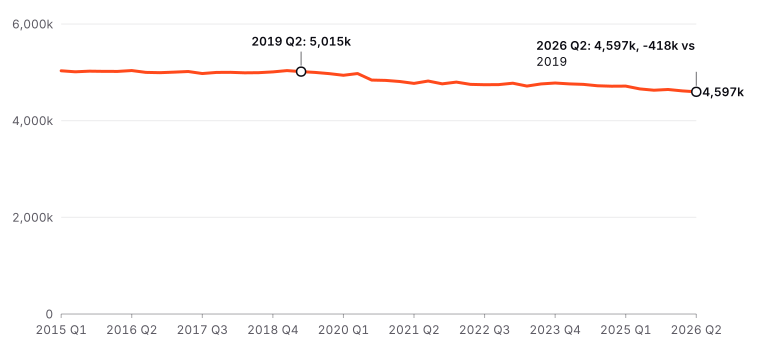
- UK wholesale and retail jobs stood at 4.597 million in Q2 2026, 8.3% below 2019 and the lowest since 1994 (ONS); EU-27 retail hours rose 4.5% between 2021 and 2025 (Eurostat).
- Target (nearly 2,000 stores), Walmart (1.5 million associates), Tesco (around 280,000 colleagues) and WHSmith (300+ stores) now put AI or headset tools in store staff's hands; none has a controlled test of the sales effect.
That figure comes from the worldwide out-of-stock study published by FMI, GMA and CIES in October 2002, which pooled 52 studies, 661 outlets and 71,000 shoppers in 29 countries. No newer worldwide study with a published method exists, and the answer it gives still holds: a gap begins in the store's own routines, not in the brand's factory.
The retailer's task queue is the ordered list of jobs a store worker's device tells them to do next: replenish, re-face, answer a customer, fix a price. Whoever feeds that list decides which gaps get closed first.
The challenge: fewer hands in UK stores, the same shelf to fill
In the UK the store team is shrinking. Office for National Statistics workforce jobs data put wholesale and retail employment at 4.597 million in Q2 2026, 418,000 (8.3%) fewer than in Q2 2019 and the lowest level since 1994. Retail alone had 2.75 million jobs in June 2026, a record-low four-quarter average, with part-time jobs, the backbone of store shifts, also at a record low, according to the British Retail Consortium's September 2026 release.
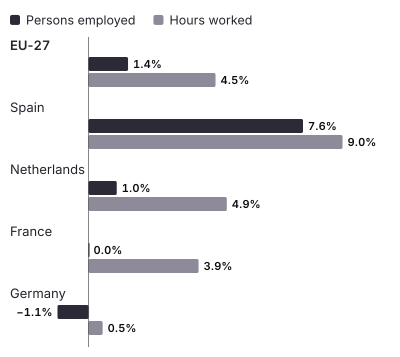
Continental Europe looks different, and a brand that copies the UK story across the Channel will misread its own markets. Eurostat labour input data show EU-27 retail persons employed up 1.4% and hours worked up 4.5% between 2021 and 2025. Germany (-1.1%) and Poland (-4.6%) lost headcount; Spain added it. The continental squeeze is on cost per hour: on Motion & Gain's calculation, the EU-27 retail wage bill per hour fell 3.5% after inflation over the same period, so retailers are pushing for more output from each paid hour rather than cutting them.
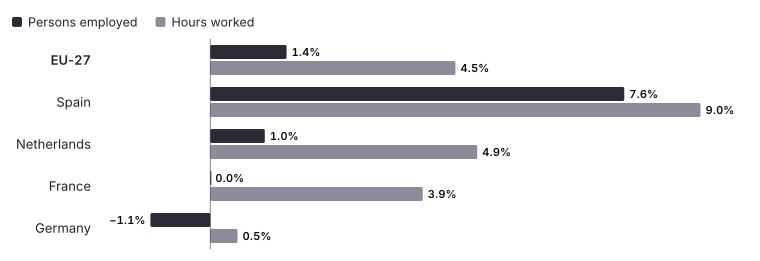
Either way, store minutes are rationed: fewer of them in the UK, each one working harder on the continent.
Who decides what the store team does next?
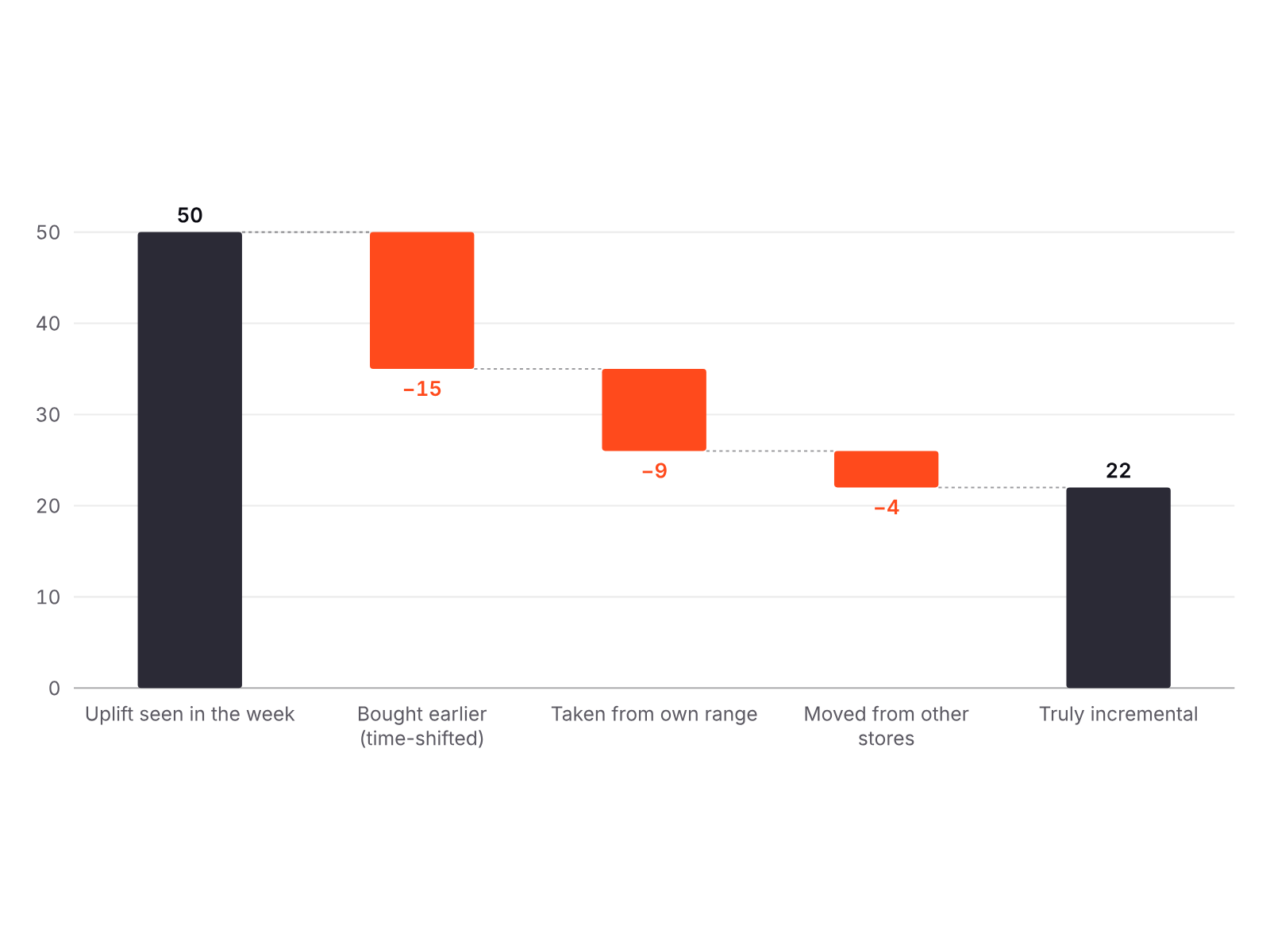
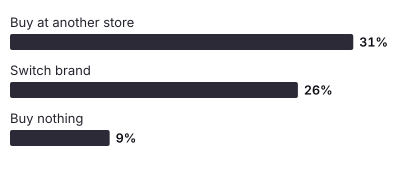
The retailer does, and increasingly through a device it owns. When a shelf is empty, the 2002 study found 31% of shoppers buy at another store, 26% switch brand and 9% buy nothing. The retailer loses the store-switchers; the brand loses at least the 35% who switch brand or walk away empty-handed.

The work that prevents those losses is now sequenced by retailer software at chain scale:
| Retailer, date and tool | Reported effect |
|---|---|
| Target (US), Jun 2024: Store Companion, a GenAI assistant on handhelds in nearly 2,000 stores | None quantified |
| Walmart (US), Jun 2025: AI task management, translation and an associate assistant for 1.5m associates, 900,000+ weekly users | Shift planning 90 to 30 minutes (manager estimate) |
| Tesco (UK), Apr 2026: AI assistant trial with around 280,000 colleagues | None |
| WHSmith (UK), Oct 2026: x-hoppers headsets for notifications and QR help requests, 300+ stores, 32 first | 'Up to +22%' in unnamed categories vs before, no control (company claim) |
Walmart's version is the clearest signal. Its AI task management tool ranks and recommends jobs for overnight stocking, and Walmart's store managers estimate it cut shift planning from 90 to 30 minutes. The order of work on the shop floor is becoming a retailer algorithm. A brand that is not in its inputs is the residual gap.
Why buying more field visits fails
A routine merchandising call arrives on the brand's calendar. The gap opens on the store's. If 47% of out-of-stocks come from store ordering and forecasting and 25% from shelf management, a rep who visits every second Tuesday finds yesterday's problem, fixes one store and leaves the ordering logic that caused it untouched. No public series shows whether brand field visits in Europe are falling, and the argument does not need one: it rests on where a gap's cause sits and who owns the tool that closes it.
The money at stake is still large. IHL Group, a retail technology analyst, estimates in its July 2026 Inventory Distortion Study that empty shelves cost retailers about $691 billion a year worldwide, though its model shows total inventory distortion falling from 10.4% of global retail sales in 2021 to 6.2% in 2026 (an IHL estimate; method not published). Brands outside the retailer's data loop risk becoming the gap that is left. We made the same point about promotions in Trade Promotion Is Your Biggest Budget: a deal that never reaches the shelf pays for nothing.
The resolution: build the perfect store inside the retailer's queue
Motion & Gain's decision rule is simple: score field sales on gaps closed through the retailer's queue, not on visits made. Four decisions follow.
1. Send data-triggered tasks, not calendar visits
Owner: head of customer development, with the category data team. Use sell-out or point-of-sale data to flag abnormal sales drops by SKU and store, and route each flag as a task the store can act on. This is the one brand-side lever with field-experiment evidence: in a study with a national retailer published in Production and Operations Management in 2016, shelf audits triggered by transaction data reduced shelf out-of-stocks, lifted sales and cost a small fraction of the benefit once running.
2. Put a joint availability KPI in the joint business plan
Owner: key account director. Agree one on-shelf availability measure per retailer, reviewed in the same meeting as promotions, and drop visit counts from the field-sales scorecard.
3. Write task content that fits the retailer's tool
Owner: shopper marketing or trade marketing. Store staff act on one line in a headset or handheld, not a planogram PDF, so write short instructions per exception type and build the store team's judgement into them: a field experiment by Kohei Kawaguchi (Management Science, 2021) found workers on average reluctant to follow algorithmic advice, and more willing once their own forecasts were built in.
4. Redeploy field time to exceptions and store-team enablement
Owner: field sales director. Move hours from routine calls to stores the data flags, and to training store staff on the categories that lose most when empty. Set the mix by market: in the UK the case is fewer hands, on the continent output per paid hour. Fewer routine calls also cut cost per visit, the cost-to-serve lever we covered in Record Diesel Prices Are a Cost-to-Serve Problem.
In the Motion & Gain commercial value chain, this sits in Corridor 3, Extract Value Through Route-to-Market Excellence: touchpoint experience (O16), touchpoint potential (O19) and cost to serve (O14).
What does the evidence show, and what does it not yet show?
Store execution pays in controlled studies. In a randomised trial at 28 Gap stores in the US (2015-16), stable scheduling with targeted staffing raised median sales 7%; a Wharton study of 437 US stores found 2-3% more sales from reallocating payroll, and Zeynep Ton's study of 268 stores linked store labour to fewer phantom stockouts.
| Study and design | Result |
|---|---|
| Stable scheduling, 28 Gap stores, US, 2015-16 (randomised field experiment) | Median sales +7%; revenue per labour hour +5% |
| Data-triggered shelf audits, national retailer (Chuang, Oliva & Liu, 2016; field experiment) | Fewer shelf out-of-stocks, positive sales effect (size not reported in abstract) |
| Store payroll reallocation, 437 US stores, 2004-05 (observational panel) | 2-3% more sales at no added cost |
| Store labour and conformance, 268 US stores, 1999-2002 (observational panel) | More labour linked to fewer phantom stockouts and better store conditions |
| Workers and algorithmic advice (Kawaguchi, 2021; field experiment) | Workers reluctant to follow the algorithm unless their own forecasts are built in |
| Retailer AI staff tools (assistants, headsets, AI task management; no controlled study found) | Evidence gap |
What nobody has shown is that the retailer AI tools themselves lift sales. WHSmith's 'up to +22%' is a before-and-after comparison in unnamed categories at one station store, with no control group, reported in the vendor's announcement. Treat the tools as a channel a brand has to earn a place in, not a proven lever, and propose a joint test-and-control trial to the retailer before anyone claims a number.
How to apply it: 30/60/90 days
- 30 days: map the staff tools at your two largest retailers, who writes the task content and what data they accept; pick the 20 SKUs where a gap costs most.
- 60 days: pilot data-triggered exception alerts with one retailer, split into test and control stores, and measure availability and sales.
- 90 days: write the joint availability KPI into the next joint business plan and rebuild the field scorecard around gaps closed.
Questions leaders ask
What is a perfect store programme worth when the retailer runs the task list?
A perfect store programme is worth what it gets into the retailer's own staff tools. Retailers such as Walmart, Target and WHSmith now put AI and headset tools in store staff's hands, and 70-75% of out-of-stocks were caused at retail level in the worldwide GMA/FMI/CIES study of 2002. A programme that scores visits made, rather than gaps closed through the retailer's queue, measures activity the shelf does not see.
Which retail execution software signals do retailers actually act on?
No public study ranks them, so treat this as Motion & Gain's view. The signal with field-experiment support is an exception flag built from transaction data: a field experiment published in Production and Operations Management in 2016 found that shelf audits triggered this way cut shelf out-of-stocks and raised sales. Retail execution software that sends such exceptions in the retailer's own format, with a one-line instruction, has the best chance of being acted on.
Should we cut field-sales visits if retailers have AI staff tools?
Cut routine calls, not field capacity. Move the time to stores where data shows a gap and to training store teams. No controlled study yet shows that retailer AI staff tools lift sales on their own, and a field experiment by Kohei Kawaguchi (2021) found workers on average reluctant to follow algorithmic advice unless their own forecasts are built in. Field teams are how a brand earns that trust.