
Since 2 August 2026, the EU AI Act has required clear labels on deepfakes and on AI-generated text published to inform the public. For marketing teams producing AI-generated content at scale, the hard part is not the label itself. It is knowing which assets need one, who decides, and proving it before the next deadline on 2 December.
Key takeaways
- 9.6% of EU enterprises already use AI to generate pictures, video or audio, and 13.5% in Germany (Eurostat, 2025).
- The Commission's guidelines treat almost all advertising examples as needing a standard label; an AI image that makes a product look better than reality counts as a deepfake.
- Breaches can cost up to €15 million or 3% of worldwide turnover, whichever is greater.
The challenge: AI-generated content is already in the marketing workflow
Generative tools moved from pilots into everyday production faster than governance did. Eurostat's 2025 survey of enterprises with ten or more employees found that 9.6% across the EU use AI to generate pictures, video or audio, 8.8% use it to generate written or spoken language, and 6.9% use AI for marketing or sales (Eurostat, isoc_eb_ai).
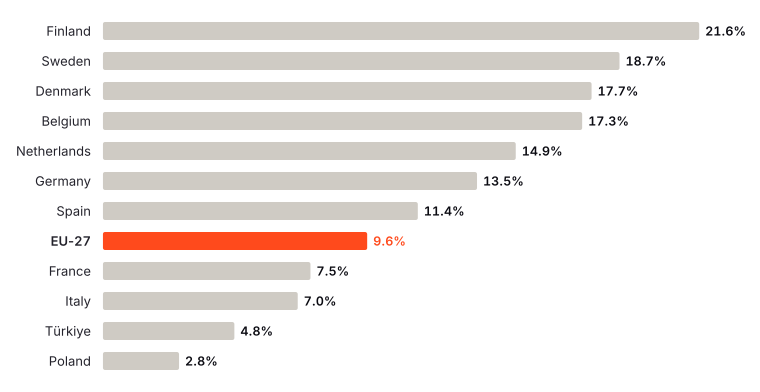
Use is far higher in some of the markets that matter most to consumer goods: 13.5% of German firms and 14.9% of Dutch firms already make images, video or audio with AI. Each of those assets now needs a decision: label or not.
The rules arrived in a rush. The Commission published its Code of Practice on marking and labelling AI-generated content on 10 June 2026. It found the code adequate on 8 July, and its final guidelines on Article 50 followed on 20 July, less than two weeks before the obligations applied.
Article 50 deadlines at a glance
- 2 August 2026: deployers must label deepfakes and AI-generated public-interest text
- 2 December 2026: machine-readable marking for generative AI tools already on the market
- 2 February 2027: watermark detection that works across tools
Why the usual fix fails
Most companies reach for one of two shortcuts. Neither holds.
"Our tools watermark it, so we are covered." The code asks AI providers to mark outputs with at least two machine-readable techniques, such as signed metadata plus an invisible watermark. But the guidelines are explicit that the provider's marking obligation "does not discharge the deployer's duty to label". The brand that publishes the ad is the deployer.
"It's advertising, so it's creative." Article 50 does allow a lighter disclosure for evidently artistic, creative, satirical or fictional work. Reed Smith's reading of the guidelines is that advertising qualifies only in "specific situations", that all the advertising examples given require standard labelling, and that "content that is exclusively informative or commercial in nature cannot benefit from reduced labeling".
That line, from the guidelines as summarised by Reed Smith, is where the commercial risk sits. It turns a creative-production question into a claims question, the same territory your legal and regulatory teams already police for packaging and pack shots.
The resolution: five decisions
1. Inventory every AI-generated asset by risk class
Map where generative AI touches published content: campaign visuals, retouched pack shots, synthetic voices, social video, chatbots, PR and thought leadership. Classify each as out of scope (assistive editing that does not substantially alter content), standard label or editorial review. The Future of Life Institute's Article 50 guide lists marketing materials among the channels to inventory.
2. Make "better than reality" a claims test
Put AI-altered product imagery through the same substantiation step as any product claim. If the AI changes how the product looks, performs or what it contains, label it, or change the image.
3. Use the EU icons, at first exposure
Article 50(5) requires disclosure "in a clear and distinguishable manner at the latest at the time of the first interaction or exposure". The code finalised three EU icons: fully AI-generated, AI-modified and a basic icon with a second layer. A line hidden in a website footer does not qualify. Build the icons into templates so labelling is the default, not an afterthought.
4. Document human editorial control for text
AI-generated text published to inform the public on matters of public interest is exempt if it has undergone "human review or editorial control" and a person or company holds editorial responsibility. Cursory sign-off does not count. Name the editor, record the review and keep the log.
5. Write it into agency and platform contracts
Require agencies and content platforms to declare AI use per asset, keep provenance metadata intact and meet the 2 December marking deadline for their tools. Code signatories (about 190 by 31 July, per Paul Weiss) are the easier partners.
What is at stake
Penalties for breaching the transparency rules reach up to the greater of €15 million and 3% of worldwide turnover, according to Paul Weiss. The larger cost is trust: an unlabelled AI pack shot that a consumer or competitor exposes becomes a claims dispute and a reputational story at once. The opportunity is the reverse. Teams that build labelling into production keep their speed, because every asset goes out cleared.
Outside the EU. Brands running pan-regional creative from Istanbul, Dubai or Zurich that reaches EU audiences are better served by one labelling standard than by two.
How to apply it: 30/60/90 days
- Days 1–30: inventory AI use across campaigns, retail content and agencies; classify assets; stop publishing AI-altered product imagery without a claims review.
- Days 31–60: add the EU icons to creative templates; set up the editorial-review log for AI-assisted text; brief brand, legal and agencies together.
- Days 61–90: update agency and platform contracts; confirm your tools' marking plans before 2 December; add AI labelling to the creative sign-off checklist and audit a sample each quarter.
Governance like this is part of a wider AI operating model; see Who Owns the AI P&L? This piece is not legal advice; take counsel on your specific case.