
Record diesel prices are not a freight problem that procurement can negotiate away; they are a cost-to-serve problem that only a commercial redesign can fix. With diesel at the pump up 40% in a year across the European Union, the consumer businesses that protect margin in 2027 will be the ones that change who they deliver to, how often and at what order size, and let AI reprice those choices every week.
Key takeaways
- EU diesel consumer prices were 40.1% higher in September 2026 than a year earlier, and 47.7% higher in Germany (Eurostat).
- Procter & Gamble now expects a $1.4 billion after-tax hit from raw materials, energy and transportation in fiscal 2027, an 11% drag on core EPS growth.
- If fuel is 25–30% of a truck's operating cost, a 40% diesel rise adds roughly 10–12% to the cost of every drop before any rate negotiation (Motion & Gain analysis).
How far have diesel prices moved in Europe?
According to Eurostat's harmonised consumer price data, released on 16 October 2026, diesel in the EU-27 cost 40.1% more in September 2026 than in September 2025. Germany was at 47.7%, France at 44.1%, Italy at 34.8% and Spain at 34.0%. The jump began after the war in the Middle East started on 28 February 2026 and, after easing in early summer, accelerated again from August.
The European Commission's Weekly Oil Bulletin put the EU average pump price at a record €2.24 a litre at the start of October 2026, against €1.59 in February, Euronews reported on 1 October 2026. Twelve member states set new highs. In the United States, Bain & Company notes that diesel passed $6.50 a gallon in September 2026, above the June 2022 record of $5.81.
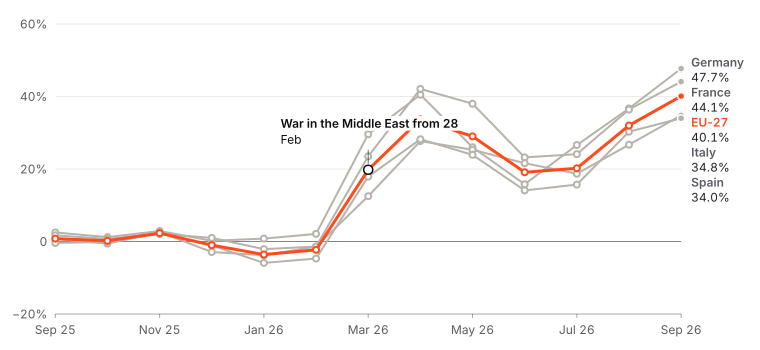
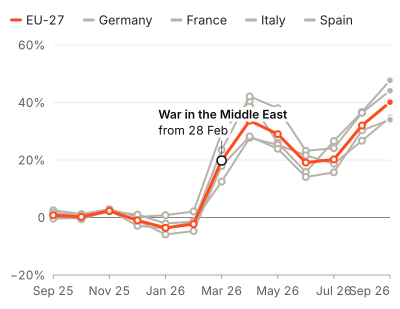
Every large EU economy sits between 34% and 48% above last year, so a multi-country business has no cheap lane to shift volume to.
Where does the cost land in a consumer business?
The bill is already in the results. Procter & Gamble's fiscal first-quarter release of 22 October 2026 raised its expected commodity headwind for fiscal 2027 to about $1.4 billion after tax, citing raw materials, energy and transportation; with interest and currency effects, P&G puts the combined drag at 11% of core EPS growth. Its core gross margin fell 150 basis points in July–September 2026, and commodity costs alone took 140 of them.
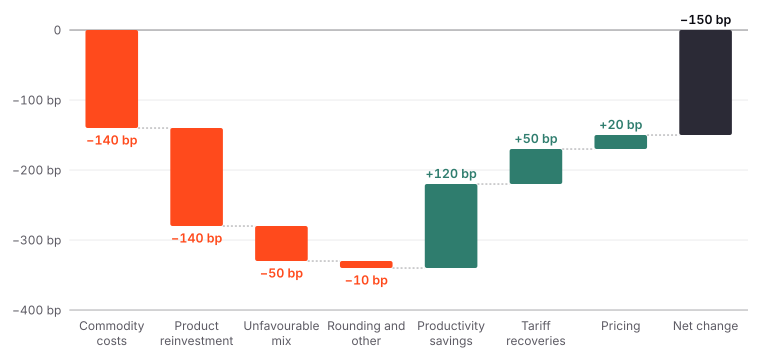
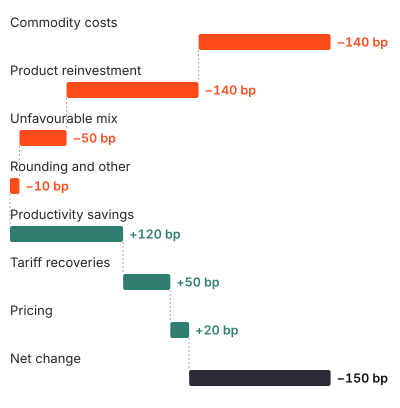
The point of the bridge is the gap: P&G found 120 basis points of productivity and still lost margin, while pricing added only 20 basis points. Coca-Cola followed a week later. Reuters reported on 27 October 2026 that record diesel was pushing up its freight and transport costs, while its prices rose only about 1% in the quarter, at a time when packaged-goods makers are wary of asking shoppers to pay more.
That is the trap. Volume-led growth, which we argued for in Price Has Stopped Carrying Growth, means more cases moving through the network at exactly the moment each case costs more to move. Price cannot carry the fuel bill, so the network has to.
Cost to serve is the full cost of getting a product from the factory to a specific customer or outlet: transport, handling, order processing, delivery frequency, drop size, returns and the trade terms attached to that customer. It varies far more between customers than between products.
Why is the fuel surcharge the wrong fight?
Most companies respond to a fuel spike by renegotiating surcharge clauses. That matters, and Bain's advice to peg surcharge tables to an official weekly diesel index is sound. But a surcharge only decides who pays for each kilometre. It does not change how many kilometres the business asks for.
The kilometres are set by commercial decisions: the minimum order a small outlet can place, the number of delivery days a key account has negotiated, the promotion that triggers a rush of part-loads, the distributor who serves a thin rural territory with a half-empty truck. None of these sit with the logistics team. They sit with sales, key account management and revenue growth management.
Those decisions also rarely see the true cost. A McKinsey survey of North American consumer goods leaders, published in 2022, found that only 17% believed they recovered more than three-quarters of their true cost to serve. That gap was tolerable with diesel at €1.59. At €2.24 it becomes a margin leak at every small drop.
What a 40% diesel rise does to the cost of a drop
Bain estimates that fuel now accounts for 25–30% of trucking operating costs, up from about 21% in 2024. Applying that share to Eurostat's 40.1% EU rise gives a simple rule of thumb: the transport cost of each drop rises by roughly 10–12%, before carriers adjust rates and before any wage or capacity effect. The rise is the same in percentage terms for every drop, but not in what it does to margin: on a large order to a distribution centre it is noise; on a small, frequent drop to a convenience store or a traditional-trade outlet it can erase the gross margin of the order.
Method (Motion & Gain analysis): 25% × 40.1% ≈ 10.0%; 30% × 40.1% ≈ 12.0%. Fuel share is Bain's US trucking estimate; European hauliers' cost structures differ, so treat this as an order of magnitude, not a forecast.
Haulage markets confirm the direction. The IRU, Upply and Transport Intelligence European road freight benchmark showed contract rates at 148 index points in the second quarter of 2026, up 15.2 points year on year, as HGV Ireland reported in August 2026, with volumes between the large EU economies still below 2025 levels.
How AI changes cost-to-serve decisions
Cost-to-serve analysis is not new; running it weekly, at the level where the decision is made, is. An AI model that joins order lines, delivery routes, drop sizes, trade terms and the weekly diesel index can price each outlet's cost to serve as it moves, and turn that into a recommendation a sales rep or key account manager can act on: consolidate two delivery days into one, raise a minimum order, move an outlet to a distributor or to digital ordering, or shift a promotion's timing so it fills trucks instead of splitting them.
The value comes from redesigning the decision, not from the model. Someone has to own the rule that says "below this drop size, this outlet moves to a different route-to-market," and the incentive that makes the sales team accept it. That is why cost to serve belongs on the commercial agenda. In the Motion & Gain commercial value chain it sits in Corridor 3, Optimize cost to serve (objectives O14 and O15).
What to do now
- Price every drop (CFO and head of supply chain, 30 days). Build an outlet-level cost-to-serve view that includes the weekly diesel index, and rank customers by margin after cost to serve, not before.
- Set drop-size and frequency rules (sales director, 60 days). Agree minimum order values and delivery days per outlet segment, and make the exceptions visible and approved.
- Re-cut route-to-market for the tail (route-to-market director, 90 days). Move the least economic outlets to distributors, consolidated routes or B2B ordering with scheduled delivery.
- Put cost to serve into trade terms (key account managers, next negotiation round). Reward customers for full pallets, fewer delivery windows and forecast sharing, rather than paying for service levels nobody costed.
- Fix the surcharge clauses too (procurement, 30 days). Index fuel to an official weekly series, cap how often tables reset, and apply the same discipline to freight embedded in supplier prices.
The bottom line
Diesel will fall at some point, but 2027 budgets are being set now, at €2.24 a litre. The businesses that come out ahead will treat this spike as the moment to make cost to serve a commercial decision, owned by sales and revenue growth management and repriced weekly with AI, rather than a line logistics absorbs.
Questions leaders ask
How much do record diesel prices add to the cost of serving a store?
As a rule of thumb, roughly 10–12% on the transport cost of each delivery. Bain estimates fuel at 25–30% of trucking operating costs, and Eurostat shows EU diesel consumer prices 40.1% higher in September 2026 than a year earlier; multiplying the two gives the range (Motion & Gain analysis). The effect on margin depends on drop size: small, frequent deliveries to convenience and traditional-trade outlets absorb the same percentage rise on a much smaller order value, so their margin after cost to serve falls fastest.
Is a fuel surcharge enough to protect margin from diesel prices?
No. A fuel surcharge clause decides how fuel costs are split between a carrier and a shipper, and indexing it to an official weekly diesel series makes that split fair and predictable. It does not reduce the number of kilometres, drops and part-loads the business generates. Those come from commercial choices such as minimum order sizes, delivery frequency, promotion timing and which outlets are served directly, so lasting protection comes from changing those rules.
Where does AI help with cost to serve?
AI helps by pricing cost to serve at outlet and order level every week, combining order data, routes, drop sizes, trade terms and the diesel index, and turning the result into specific recommendations: consolidate delivery days, raise a minimum order, move an outlet to a distributor or to digital ordering, or retime a promotion. The return depends on whether sales and key account teams own those decisions and are measured on margin after cost to serve.