
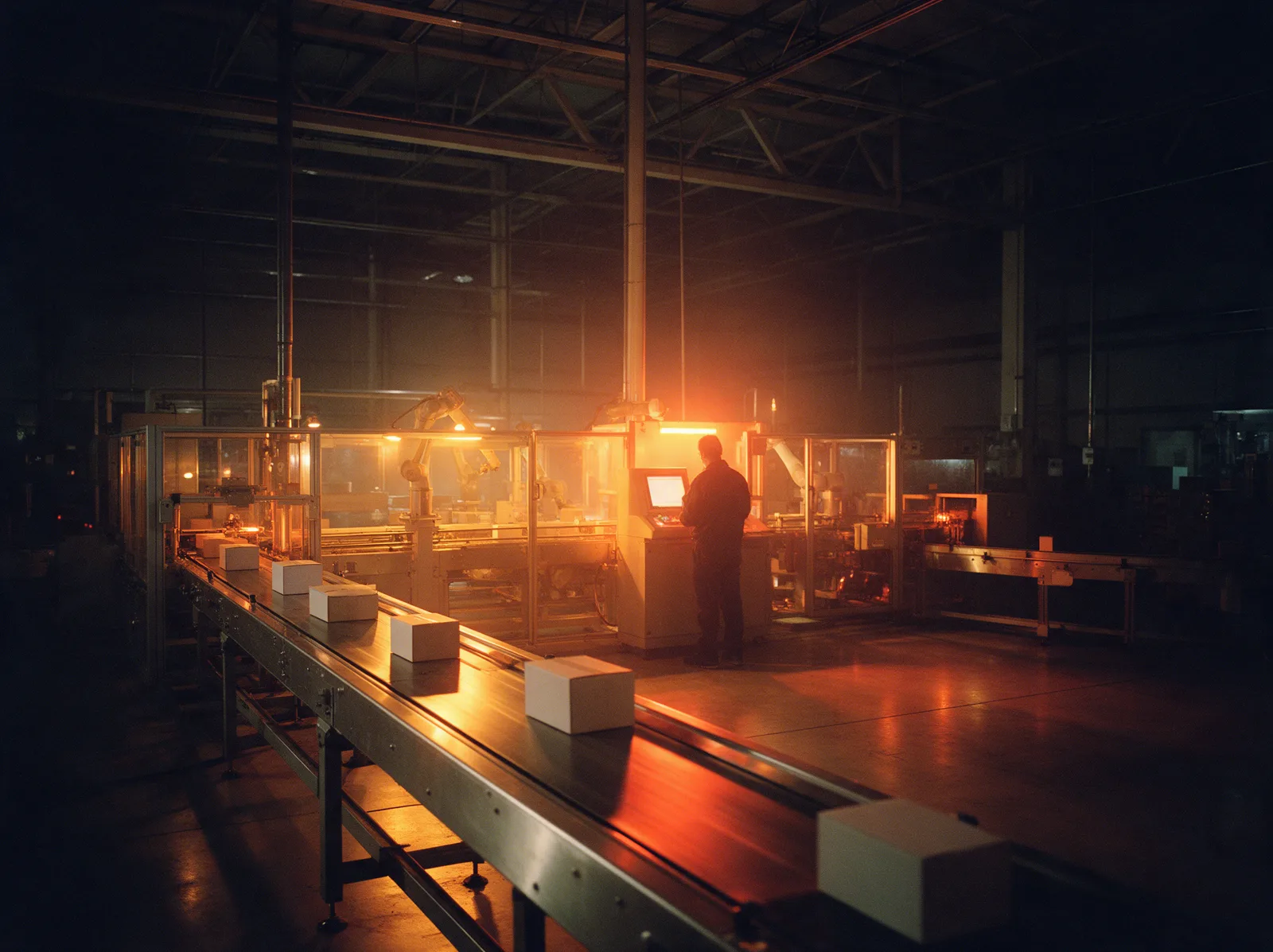
Every large consumer-goods company we checked runs a disclosed, multi-year productivity programme, and two of them, Procter & Gamble and Kimberly-Clark, are putting the weight on their factories and supply chains. Lights out manufacturing is moving from pilot to plan: P&G now puts a number on its product supply workforce. Rising costs absorb part of the savings; the rest goes into product and brand, and that is what mid-sized rivals must plan for in 2027.
Key takeaways
- P&G's 2026 investor day slides show an up to $10bn productivity target and a 2030 commitment to 20-30% fewer product supply staff, including contractors.
- On indicative comparisons, P&G (~2.9% of sales a year) and Kimberly-Clark (~2.6-3.7%) run the largest supply-led programmes; Nestlé (~1.1%) and Unilever (~0.5%) lean on overheads.
- In Jul-Sep 2026, productivity added 120bps to P&G's core gross margin while commodities took 140bps and product reinvestment another 140bps.
What did P&G commit to at its 2026 investor day?
P&G's investor day presentation of 19 November 2026 shows a productivity target of up to $10bn and, among its supply commitments for 2030, up to $1.8bn of productivity savings and a 20-30% reduction in the product supply workforce, contractors included. P&G executives said the $10bn spans fiscal 2027 to 2030 and that the $1.8bn is an annual figure drawn from cost of goods sold, according to Reuters.
According to P&G's own October 2026 account, its Product Supply organisation saved $1.5bn in fiscal 2026 and put more than $300m of that back into product and packaging improvements; the Grooming plant in Berlin, Germany, has reached a four-hour unattended night shift, and P&G aims to complete its automation roll-out globally by 2030. Against fiscal 2026 net sales of $87.0bn (P&G results), the up to $10bn averages about 2.9% of sales a year.
Lights out manufacturing is production that runs for set periods with no operators on the line, relying on automation, machine vision and remote monitoring.
Is P&G an outlier, or are all the scale players doing this?
P&G is not alone. Nestlé raised its savings target to CHF 3.0bn by the end of 2027, with about 16,000 roles going, of which about 4,000 are in manufacturing and supply chain. Unilever launched an EUR 800m, three-year programme in March 2024 covering about 7,500 roles, mainly in offices, and had delivered EUR 670m by the end of 2025. Kimberly-Clark targets more than $3bn of gross productivity by the end of the decade, all in the supply chain, including a $1bn automated distribution centre in Beech Island, South Carolina, adding productivity from 2027 (Supply Chain Dive).
| Programme and disclosures | Size and focus |
|---|---|
| P&G, FY2027-30: up to $10bn productivity; Supply 3.0 targets up to $1.8bn savings and 20-30% fewer supply staff, incl. contractors, by 2030 | ~2.9% of sales a year; supply-led; mainly reinvested |
| Kimberly-Clark, 2024 to ~2030: over $3bn gross productivity, all in supply chain; no job cut disclosed, 5,000+ staff upskilled | ~2.6-3.7% of sales a year; supply-led |
| Nestlé, 2025-27: CHF 3.0bn savings by end-2027; c.16,000 roles, of which c.4,000 in manufacturing and supply chain | ~1.1% of sales a year (3.4% if run-rate); mixed |
| Unilever, 2024-26: EUR 800m programme, EUR 670m delivered by end-2025; c.7,500 mainly office-based roles | ~0.5% of sales a year; overhead-led |
| Reckitt, 2024-27: fixed costs cut to 19.4% of revenue (20.9%) while brand investment rose to 14.6% (13.4%) | -1.5 pp fixed costs in FY2025; no savings total |
| Colgate-Palmolive: three-year programme incl. supply chain optimisation; $200-300m of charges | Savings not quantified |
Read the sizes as ranges, not a league table: the companies measure different things over different periods. P&G and Kimberly-Clark aim theirs at plants and networks, Nestlé and Unilever mainly at offices, and only P&G puts a percentage on its factory workforce.
Where do the savings go: margin, inflation or growth?
Brian Jacobsen of Annex Wealth Management put the sceptic's case on the day: "Cost cutting can protect profitability, but it can't manufacture growth" (Reuters). He is partly right. P&G's fiscal 2027 guidance already absorbs about $1.4bn after tax of higher commodity costs, up from about $1bn flagged in July (P&G Q1 FY2027 results).
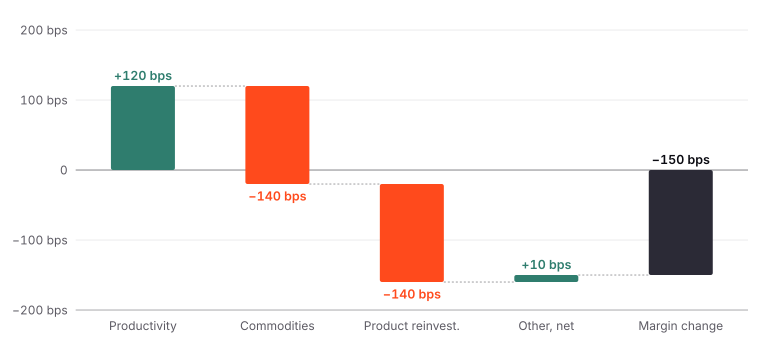
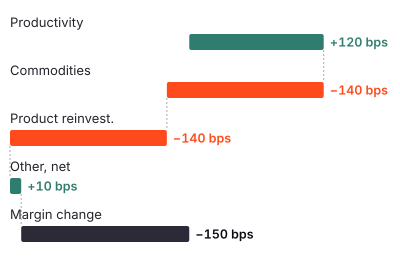
In July to September 2026, productivity added 120 basis points to P&G's core gross margin; commodities and product reinvestment took 140 each, and the margin fell 150. P&G spent slightly more on better products than productivity added. Gross margins also fell in 2025 at Nestlé (110bps, to 45.6%) and at Kimberly-Clark (140bps, to 36.0%), per their annual results.
What survives inflation goes into product and brand. Reckitt cut fixed costs to 19.4% of net revenue in 2025 from 20.9% while raising brand equity investment to 14.6% from 13.4%. Unilever spent 16.1% of turnover on brand and marketing in 2025, up 10bps, and Nestlé 8.6% of sales on advertising and marketing, which it said reflected increased investment. The leaders absorb the same inflation as everyone else and still fund the shelf.
Why EU statistics do not show lights out manufacturing yet
The headcount change is a 2027-2030 plan, not yet a measured fact. In the EU-27, employment in food and drink manufacturing (NACE C10-C12) rose 7.3% between 2015 and 2024 and in chemicals 9.4%, while real value added per person in food and drink fell 1.7% (Eurostat national accounts). Investment is moving first: the International Federation of Robotics counted 5,300 new industrial robots in EU food and beverage plants in 2025, up 4%, while total EU installations fell 11% to 60,500.
What should mid-sized suppliers plan for in 2027?
What follows is Motion & Gain's judgement; no public data covers mid-sized suppliers' programmes. The threat is several better-funded leaders reinvesting at once, in product, brand and retailer execution, while carrying the same commodity bill. As a yardstick, a supplier with EUR 500m of sales would need about EUR 15m of savings a year to match P&G's ~2.9% of sales, before inflation takes its share.
- Map where the leaders reinvest, category by category (CCO and insights lead, 90 days): track pack upgrades, media weight and promotional depth of the top two scale players in your five largest categories.
- Choose the categories to contest and the ones to hold for cash (CEO and CFO, by the 2027 budget): put brand money where you can win on product or local relevance.
- Buy automation rather than build it (supply chain director, 90 days): price co-manufacturing, shared warehousing and contract logistics against your own capex.
- Redesign cost-to-serve decisions with your own data (supply and sales leads, 90 days): drop size, order frequency and service levels by customer are where your own savings usually sit; see our services.
The bottom line
Supply automation is becoming the scale players' funding engine, and P&G has said how far it will take its factory workforce. Plan 2027 against several better-funded leaders, not one. This piece sits in Corridor 3, Route-to-Market Excellence, covering cost to serve (O14) and coverage and revenue (O18) in the Motion & Gain value chain.
Questions leaders ask
Do automation savings reach shoppers as lower prices?
None of the companies reviewed links its savings to shelf prices or retailer terms. The disclosed uses are offsetting commodity costs and reinvesting in product and brand: in July to September 2026, P&G's product reinvestment took 140 basis points of core gross margin, matching the commodity hit.
Is lights out manufacturing realistic for a mid-sized supplier?
Unattended shifts need high-volume, stable lines and vision-based quality control, which favours large plants. For most mid-sized suppliers the better return lies in buying automation through co-manufacturers and shared logistics, and in cutting cost to serve with their own order data.