

From 30 December 2026, a chocolate or coffee brand that buys its beans from an EU importer files no EUDR due diligence statement, yet it may not sell without its supplier's statement reference number on record. The EU Deforestation Regulation puts the paperwork on the first company to place the commodity on the EU market and leaves the commercial exposure downstream. Run the first 90 days as a commercial plan, owned by the commercial team.
Key takeaways
- The EU imported EUR 31.2bn of coffee and cocoa beans in 2025; at least 79% of the cocoa bean value came from standard-risk origins.
- The main obligations apply from 30 December 2026 (30 June 2027 for most micro and small operators); downstream companies file no statement but must hold supplier details, including the DDS reference where the supplier is an operator, before selling.
- Commercial effects are reported, not measured: about USD 50 a tonne extra for compliant Vietnamese coffee, USD 30-80 a tonne of unrecovered tracing costs in Nigeria.
The challenge: EUDR risk sits in standard-risk cocoa, palm and soy
EU-27 coffee imports from outside the EU reached EUR 18.8bn in 2025 and cocoa beans EUR 12.4bn (Eurostat Comext, DS-045409). Brazil shipped 34% of the coffee by value; Côte d'Ivoire 38% of the cocoa beans.
Brazil, Côte d'Ivoire, Indonesia and Malaysia are standard risk; low-risk origins such as Vietnam and Ghana get simplified due diligence, and none of the four high-risk countries matters here (Implementing Regulation (EU) 2025/1093).
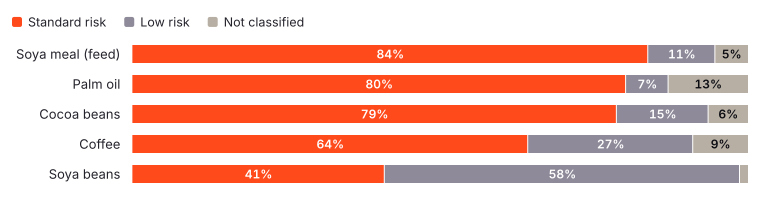
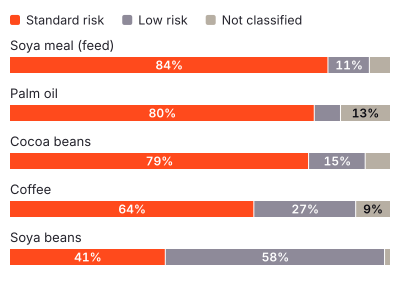
At least 79-84% of cocoa bean, palm oil and soya meal import value came from standard-risk origins in 2025; soya beans are the exception, with 58% from low-risk origins.
The 2025 jump in import values was price, not volume: coffee rose 38% on 1.5% less volume, and the implied cocoa bean price per tonne rose 56%. In 2026 that has turned: from January to September the implied import price fell 32% for cocoa beans and 11% for coffee on slightly higher volumes (Motion & Gain analysis of Eurostat Comext).
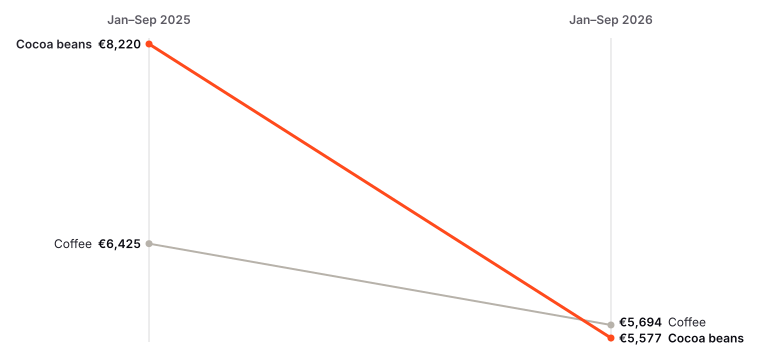
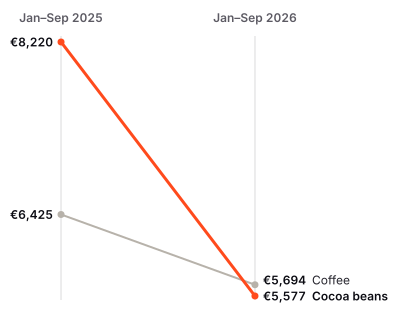
So the rules arrive as input prices ease, not at their peak. A compliance premium is a bigger share of a falling price, and buyers have more room to argue about who absorbs it.
What applies on 30 December, and to whom?
Article 38 of the consolidated Regulation (EU) 2023/1115 applies the core obligations from 30 December 2026, and from 30 June 2027 for micro and small operators established by 31 December 2024 (EUR-Lex). The first placer runs due diligence, files the due diligence statement (DDS) and passes its reference number down the chain.
| Role and duty | When and what is filed |
|---|---|
| Upstream operator, large or medium: first to place on the EU market; runs due diligence and passes its DDS reference number downstream | From 30 Dec 2026: files a DDS before placing |
| Upstream micro or small primary operator: makes a one-off simplified declaration in the Information System and passes on its identifier | Most from 30 Jun 2027: simplified declaration, no DDS |
| Downstream operator or trader, non-SME: holds supplier details before selling, keeps them 5 years; registers; verifies on concerns | From 30 Dec 2026: no DDS; needs the DDS reference if the supplier is an operator |
| Downstream operator or trader, SME: keeps supplier and buyer details 5 years; no registration or verification | No DDS; same reference rule; medium from 30 Dec 2026, most micro/small 30 Jun 2027 |
The date is not moving. In its review of 4 May 2026, COM(2026) 191, the Commission declined further changes to the basic text "to preserve legal certainty" (European Commission). The product list is settled too: Delegated Regulation (EU) 2026/2102, published in September, keeps palm oil, palm kernel oil and existing palm derivatives such as glycerol and fatty acids in scope from 30 December 2026; modified palm oils, further oleochemicals, soap, soluble coffee extracts and frozen cattle tongues follow from 30 December 2027.
Enforcement is coming, unevenly. On 12 November 2026 the Bundestag passed Germany's law, with fines of up to 4% of EU-wide turnover for larger companies (Deutscher Bundestag); the Bundesrat gave a first opinion on the draft on 25 September (Drs. 438/26 B), and final passage is pending. Dutch enforcers are preparing to act from 30 December (Tweede Kamer, 27 August 2026). On 19 November, with six weeks to go, the Commission opened infringement procedures against Bulgaria, Greece, Malta and Poland for failing to designate competent authorities, the bodies that check companies and impose penalties; Bulgaria lacks one only for rubber (European Commission, INF/26/2269). We found no tolerance period on a primary page.
Why leaving deforestation rules to sustainability fails
A sustainability team can confirm a supplier is registered. It cannot decide who pays for tracing, or which SKU switches origin when a lot fails. The early signals are commercial, and still only reports.
StoneX's CoffeeNetwork cited unnamed reports of a premium of about USD 50 a tonne for compliant Vietnamese coffee, with only 35-40% of output thought compliant (StoneX, August 2026). Nigerian exporters Sunbeth Global and Starlink Global and Ideal told Reuters that tracing costs them USD 30-80 a tonne, not yet recovered from European buyers (Reuters via TimesLIVE).
By our arithmetic, USD 50 is about 0.9% of the 2025 import value per tonne of Vietnamese coffee. USD 30-80 is 0.5-1.2% of the January to September 2026 cocoa bean import price per tonne. The direct cost is small. Access to compliant lots, and who absorbs the cost, is the risk.
The resolution: four commercial decisions
This is Motion & Gain's judgement for suppliers selling into EU retail. It is not legal advice.
1. Map exposure SKU by SKU
List every SKU with cocoa, coffee, palm or soy, its upstream operator, origins and benchmark class, and flag those resting on one standard-risk origin. Personal-care ranges are exposed in 2026 through palm inputs such as palm oil, glycerol and fatty acids; finished soap joins in 2027. That list shows the CFO where margin is at risk.
2. Put the reference number in upstream contracts
Make the DDS reference number (or a small supplier's declaration identifier) a condition of each shipment, with a remedy when it is late. Agree now who carries tracing costs, before they arrive as a surcharge.
3. Prepare the retailer evidence pack
Add a deforestation line to the SKU-level evidence file for the 2027 negotiations: origins and confirmation that upstream operators hold plot geolocation. In our judgement it should also list the reference numbers you hold. GS1 Germany's guideline, by contrast, passes DDS references from importer to manufacturer but only an applicability flag to the retailer (GS1 Germany, July 2026). Answering before the buyer asks is leverage.
4. Set price and range contingency
For flagged SKUs, decide in advance: a second compliant origin, a recipe change or a temporary delist. Price any compliant-lot premium into the 2027 cost case rather than absorbing it in March.
How to apply it: the first 90 days
- By 30 December (procurement director, category heads): exposure map for top SKUs; reference numbers confirmed for every first delivery.
- By end of January 2027 (commercial director, legal): contract clauses agreed; evidence pack in every key-account file.
- By end of March 2027 (CCO, finance): contingencies tested; premiums and tracing costs priced into terms.
In Motion & Gain's commercial value chain, this sits in Corridor 3, Extract Value Through Route-to-Market Excellence, under Optimize cost to serve: supply continuity and tracing costs feed distribution efficiencies (O14), and the retailer evidence pack is trade engagement (O15).
Questions leaders ask
Do downstream companies file an EUDR due diligence statement?
No. Under Regulation (EU) 2023/1115 as amended in December 2025, downstream operators and traders file none, but may only sell once they hold their suppliers' details, including the DDS reference number where the supplier is an operator, kept for five years; larger ones must also register.
Which categories carry the most exposure under the EU rules?
Cocoa, palm oil and soya meal, mostly sourced from standard-risk origins.
Will the 30 December deadline be postponed again?
Nothing on the record says so: the Commission's May 2026 review proposed no further changes, Germany and the Netherlands are preparing enforcement, and the Commission has opened infringement cases against four member states over enforcement authorities not yet designated. Plan for 30 December 2026.