
Three-quarters of EU wholesale turnover is still ordered outside any web shop, app or EDI link, and at the one large distributor we found that reports where its orders start, orders arriving in the customer's own inbox grew faster than sales. B2B ecommerce is becoming multi-origin. The supplier's app keeps winning where the manufacturer owns the route; elsewhere, the order goes to the supplier whose prices and stock every route can read.
Key takeaways
- About three-quarters of EU wholesale turnover is still ordered by phone, typed e-mail, rep or counter; e-commerce reached only 24.9% of turnover in Eurostat's 2025 survey, from 23.1% in 2018.
- Ingram Micro's Email-to-Order processed about USD 1.6bn in Q3 2026, up 33%, faster than its 20.8% sales growth, while its self-serve portal also rose to about 70% of orders.
- AB InBev captures 73% of revenue through B2B digital platforms: the app wins where the manufacturer owns the route. Elsewhere, our view is one data layer that e-mail, EDI and agents can all order from.
The challenge: where do B2B ecommerce orders actually start?
Most consumer-goods sales directors carry a 2027 budget line for a B2B ordering app, judged by outlets signed up. That says nothing about where orders start. In the 2025 survey of EU enterprises with ten or more staff, wholesalers sold 24.9% of turnover through e-commerce, which leaves 75.1% ordered by phone, fax, typed e-mail, rep or counter (Eurostat; the remainder is our calculation).
Multi-origin ordering is a route to market in which one customer's orders can start in several places: the supplier's app, the customer's own purchasing system (EDI), an e-mailed purchase order, a rep, and now an AI agent acting for the buyer. The supplier's job is to accept all of them against one price and one stock position.
The digital quarter is not mostly apps either. EDI orders, sent from the customer's own system, carried 15.3% of EU wholesale turnover; web shops, apps and marketplaces carried 9.45%, of which B2B web ordering was 7.34% (Eurostat). The survey counts a typed e-mail as offline, so e-mailed orders sit in the outside-e-commerce bar below (CSO Ireland, survey definition).

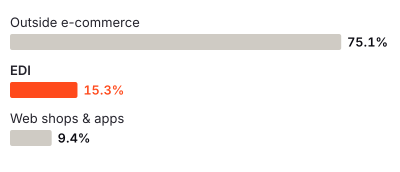
The biggest digital route into an EU wholesaler already starts on the customer's side, and the biggest block of orders is not digital at all. Have eight years of portal building shifted that? Barely.
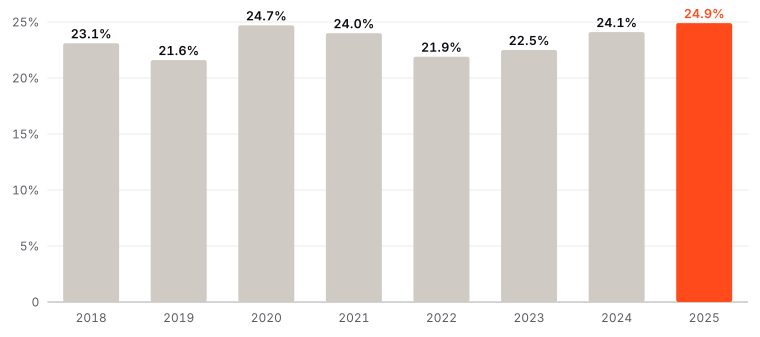
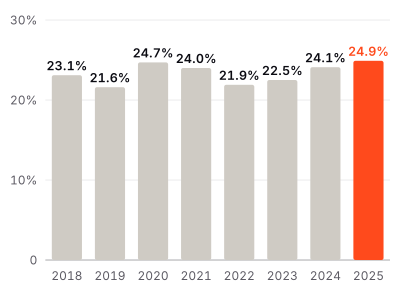
Wholesale e-commerce never left a band of 21.6% to 24.9% of turnover between the 2018 and 2025 surveys. The series cannot say why, but the bulk of trade orders has not moved onto suppliers' screens.
Why pushing every customer onto your app is not enough
The strongest counter-case is AB InBev. On 30 September 2026 its BEES platform was live in 30 markets and the brewer captured 73% of revenue through B2B digital platforms, up from about 70% a year before (AB InBev, Q3 2026 results; Q3 2025). AB InBev does not define "B2B digital platforms", so the figure may cover more than the app. Even so, this is not a failing bet.
The route explains it, in our reading. BEES connects AB InBev directly with more than 6 million customers, and where a manufacturer sells straight to an outlet that has no purchasing system of its own, the supplier's app becomes the customer's system. Unilever's eB2B platform in Asia had nearly 500,000 retailers live in April 2025, and its reps used AI assortment suggestions in short visits (Unilever, dated background). App and rep, not app instead of rep.
Those conditions break in the other half of consumer-goods trade: the distributor carrying hundreds of suppliers, the wholesaler buying from its own ERP, the cash-and-carry customer who e-mails a list. None of them will open forty supplier apps. Across all EU manufacturing, EDI carried 17.9% of turnover in the 2025 survey and B2B web ordering only 3.6% (Eurostat).

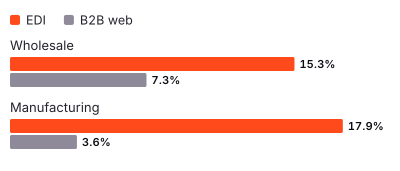
For a supplier, the digital order mostly arrives from the customer's machine, not from the supplier's screen.
Vendor data hints at where apps stall, from companies selling the alternative. WizCommerce, drawing on more than 250 wholesalers on its platform, puts median use of digital order-writing tools at 46% of licensed rep seats (WizCommerce benchmark, via Distribution Strategy Group; vendor data). nFuse, a start-up taking FMCG trade orders over WhatsApp, claims more than 70% retailer adoption against about 15% for conventional platforms (Tech Funding News; unverified company claim). Treat the app as the only digital route and most customers keep ordering the old way, while somebody re-keys their e-mails.
The resolution: four decisions that make you easy to order from
What follows is Motion & Gain's position for FMCG, not a finding: no consumer-goods company yet reports orders placed by customers' AI agents. Keep the app where you own the route, and build underneath it one data layer that every order route reads.
1. Put customer price, stock and catalogue on one layer
The app, the EDI link, the e-mail parser and any agent should read the same customer-specific price list, the same available-to-promise stock and the same product attributes. Kept apart, every order arriving outside the app needs a person to reconcile it. The commercial director owns the price file; IT owns the plumbing.
2. Run e-mail and EDI as channels, with targets
Ingram Micro, the technology distributor, shows the scale this can reach. Its Email-to-Order service reads a customer's e-mailed purchase order and places it; in Q3 2026 it processed about USD 1.6bn of revenue, 33% more than a year earlier, while net sales grew 20.8% to USD 15.2bn (Ingram Micro, Q3 2026 earnings deck; results release). That is roughly a tenth of quarterly sales by our calculation, from customers who also have a mature portal. Sales operations should report orders by origin every month and set a target for automated intake.
3. Open an agent endpoint, on your own terms
By the end of Q3 2026 Ingram Micro had launched ordering in 12 countries over the Model Context Protocol (MCP), an open standard that lets AI assistants call a company's systems. Through one authenticated, audited endpoint a customer's assistant can search the catalogue, quote, order, check price and availability and pull invoices (Ingram Micro deck; earnings call). Walmart's consumer-side Agent Gateway adds Agent Profiles, rolling out in November, that let shoppers require approval for each purchase or set a spending limit (TechCrunch, October 2026). A consumer-goods supplier faces the same choices: which customers, ranges and credit limits, and which orders still need a human. We set out the range question in Agents Can Now Buy.
4. Give the rep the exceptions, not the re-keying
Forrester's 2027 forecast has AI agents influencing 75% of B2B purchase decisions, without defining "influence", and expects fully autonomous buying to stay with high-volume, low-risk, repeat purchases (Forrester, forecast). Gartner found that 67% of 646 B2B buyers prefer buying without a rep (Gartner, via Digital Commerce 360). So the routine reorder goes to whichever route the customer prefers, and the rep's hours go to listings, range changes, promotions and problems.
Evidence: what Ingram Micro reports, and what it does not
Ingram Micro is the one large distributor we found that publishes figures on orders starting outside its own portal. Its Q3 2026 numbers:
| Ingram Micro | Q3 2026 | Change |
|---|---|---|
| Email-to-Order revenue | USD 1.6bn | +33% y/y |
| Net sales | USD 15.2bn | +20.8% y/y |
| Self-serve orders | ~70% | up >10 pts |
| Active MCP customers | n.d. | >3x q/q |
| MCP ordering countries | 12 | n.a. |
| YTD sales rate, MCP* | 3.7x | n.a. |
Ingram reports a 3.7x "year-to-date sales rate" for active MCP customers versus customers not integrated. That is a correlation among self-selected adopters, not an uplift to plan on: bigger, more digital customers usually connect first, and Futurum, an independent analyst firm, makes the same point (Futurum Research). The plainer figure matters more for FMCG. In the same quarter Ingram's self-serve share rose by more than 10 points to about 70% of orders. The portal grew and the inbox grew faster: multi-origin ordering, not app versus agent.
How to apply it: a 30/60/90-day plan
- Day 30, baseline (sales operations): count orders by origin (app, EDI, e-mail, phone, rep, counter) for your top 50 customers and a sample of small outlets, and split customers into those where you own the route and those where you are one supplier among many.
- Day 60, data layer (commercial director with IT): test whether customer price, stock and attributes can be read from one place; pilot automated intake of e-mailed orders with one distributor and measure the re-keying it removes.
- Day 90, agent policy and KPIs (sales director): decide which customers, ranges, credit limits and approvals an agent may use, and pilot one endpoint with a customer that already orders by EDI. Reset the 2027 app KPIs to the share of orders captured digitally across all routes.
The rule that falls out: where you own the outlet relationship, keep funding the app; where you are one of many suppliers, fund the data layer first. Every re-keyed order is cost to serve the customer never sees (we priced the delivery side in our diesel piece).
In the Motion & Gain value chain this sits in Corridor 3, Extract Value Through Route-to-Market Excellence: digital-first adoption including B2B ordering (O17), distribution efficiencies (O14) and touchpoint potential (O19).
Questions leaders ask
Is the B2B ordering app the wrong bet for consumer-goods companies?
No. Where a manufacturer owns the route to small outlets, its app can carry most of the business: AB InBev captured 73% of revenue through B2B digital platforms at the end of September 2026. The app is a weaker bet where the supplier is one of many in a distributor's or retailer's own systems, which order by EDI, e-mail or rep. The decision is not app or no app, but which route each customer segment actually uses.
What does a supplier need before an AI agent can order from it?
An agent needs what a human buyer reads: the catalogue with clean attributes, the customer's own price, live availability, order status and invoices, behind authentication and an audit trail. Ingram Micro exposes these through one MCP endpoint. Consumer retail shows the gap: in BCG's 2026 survey only 18% of large retailers called their marketplaces agent-ready (BCG). No equivalent figure exists for FMCG suppliers.
How should we measure B2B ecommerce when orders arrive by many routes?
Measure the share of orders captured digitally across every route (app, EDI, automated e-mail intake and agents) on the same customer base, by customer segment. App downloads reward pushing customers onto one screen; an origin-based measure rewards being easy to order from.