
French national-brand suppliers asked retailers for about 3.5% more in the 2026 round and got 0.05%. Regulators across Europe are now going after retail buying power under unfair trading practices rules, but none of their cases will bind the 2027 negotiations that open on 1 December. Suppliers should bring a checkable evidence file and one negotiation owner, not wait for a ruling.
Key takeaways
- In France's 2026 round, national-brand suppliers asked for about +3.5% and got +0.05% triple net.
- Bulgaria's EUR 75.65m Kaufland fine (9 November 2026) is about 1.8 times all EU UTP fines reported for 2022–2024 (EUR 41.9m), and can be appealed.
- Nothing binds the round that closes on 1 March 2027; EU cross-border enforcement applies from 10 September 2027.
The challenge: suppliers asked +3.5% and got +0.05%
The Observatoire de la négociation commerciale found French national-brand suppliers opened the 2026 round at around +3.5% and closed at +0.05% triple net (French ministries, April 2026). Retailers demanded proof of the raw-material share in 65% of cases.
Ilec, the brand manufacturers' association, says French law's protection of that share held in only 37% of cases, in a member survey with no published method (Presse Agence, November 2026). In the European Commission's review of the 2019 Directive, 29% of suppliers surveyed named fear of retaliation as a major barrier to complaining (European Commission, December 2025).
Are unfair trading practices rules enforced harder now?
In places, yes, under the national laws that transpose Directive (EU) 2019/633. On 9 November 2026 Bulgaria's Commission for Protection of Competition fined Kaufland Bulgaria EUR 75.65m (Capital.bg; Squire Patton Boggs) for demanding price "improvements" from meat and dairy suppliers, folding service fees into discounts without a clear return service, and stalling price increases.
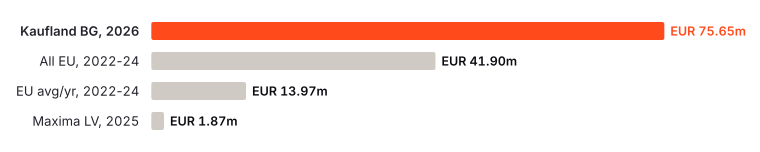
One decision against three years of national totals is an uneven comparison, and this one is contested. Capital.bg notes that the authority rated the violations "not particularly severe", that the practices look common among Bulgarian chains, and that the decision quantifies no supplier's loss. Kaufland calls the fine "completely disproportionate compared to European practice" and says it will appeal within the 14 days allowed; no filing is confirmed.
Latvia fined Maxima Latvija EUR 1.87m in October 2025 for sitting on suppliers' price-increase requests for three to 12 months (Latvian Competition Council). On 12 November 2026 the investigation services of France's Autorité de la concurrence notified a report finding that the AURA buying alliance of Auchan, Intermarché and Casino is likely to harm competition (Autorité de la concurrence); it is a report, not a decision. Enforcement stays patchy: four Member States ran 90% of UTP investigations in 2021–2024 (European Commission evaluation).
Enforcement is a lever a supplier can name in the room. It is not yet a remedy.
Why waiting for the regulator fails in the 2027 round
| Date and event | Effect on the 2027 round |
|---|---|
| 9 Nov 2026 · Bulgaria: the competition authority fines Kaufland EUR 75.65m under UTP rules; 14 days to appeal | Bulgaria only; Kaufland says it will appeal |
| 12 Nov 2026 · France: Autorité de la concurrence investigators notify a report on the AURA buying alliance | Not a decision; two months for observations |
| 1 Dec 2026 · France: the annual negotiation round opens | The window starts |
| About mid-Jan 2027 · France: the AURA observation period ends (two months from 12 Nov) | No date set for the decision |
| 1 Mar 2027 · France: deadline for 2027 agreements | The round closes with no binding remedy |
| 10 Sep 2027 · EU: Regulation (EU) 2026/697 on cross-border UTP enforcement applies | Six months after the round closes |
The Autorité's board then decides on AURA, with no date set. Regulation (EU) 2026/697 adds no new banned practices; it makes national authorities cooperate on cross-border cases (EUR-Lex). The Bulgarian and Latvian decisions apply only to the chains and markets concerned. A supplier can cite these cases; it cannot count on them before 1 March.
The resolution: four decisions before 1 December
1. Build the evidence file SKU by SKU
One line per SKU: cost exposure, raw-material share, the date each cost moved, and a source for each number. It turns our 8 November case for where a 2027 price increase is justified into something a buyer can check.
2. Log pressure against what regulators actually fine
Record every price "improvement" request, every service fee moved into a discount, and every price-increase request with three dates: sent, answered, effective. Those are the behaviours behind the Kaufland and Maxima fines. A dated log turns a grievance into a file a mediator can use.
3. Make the file readable by software
Walmart's documented use of Pactum's bot, reported in 2023, covered equipment suppliers, not goods it sells (Fox Business). Duvo.ai's chief executive says its agent accepts or rejects supplier price requests SKU by SKU for Holland & Barrett and Heureka, with a person in the loop; that is the vendor's account (Modern Retail, June 2026). It is a direction of travel; a structured file serves a human buyer and software alike.
4. Give the negotiation one owner
One commercial owner signs off every price, concession and log entry across accounts and alliances. Split ownership is how a supplier concedes an "improvement" its own cost file contradicts.
How to apply it: three dates before the round closes
- By 19 December (commercial director, finance): evidence files for the largest SKUs; pressure log live from 1 December.
- By mid-January (key-account leads, legal): check the log against the three fined behaviours; take documented delays to a mediator.
- By 1 March 2027 (the owner): close against the file and record what was asked, obtained and why.
In Motion & Gain's commercial value chain, this sits in Corridor 3, Route-to-Market Excellence (O15, trade engagement).
Questions leaders ask
What counts as an unfair trading practice in EU grocery?
Buyer conduct banned in the agri-food chain by Directive (EU) 2019/633 or a stricter national law. Recent fines targeted routine price-cut demands, service fees folded into discounts and delayed price increases (Kaufland, Bulgaria, 2026; Maxima, Latvia, 2025).
Can suppliers use the Kaufland or AURA cases in 2027 negotiations?
As context, yes; as a remedy, no. Kaufland can appeal and the AURA report is not a decision, so neither binds the round ending 1 March 2027. The cases show what authorities fine, and so what to log.