
AI dynamic pricing is moving from airline seats to the grocery shelf, and the rules are arriving faster than the tools. The winners will use AI to price products, packs, promotions and trade terms with more precision, and will refuse to price individual shoppers. That line, not the algorithm, is now the strategic decision.
Key takeaways
- 28% of more than 2,200 business leaders surveyed by Simon-Kucher already use AI for real-time price optimisation; 41% use it to track competitor prices.
- Legislators in at least 30 US states considered pricing bills this year; Maryland, New Jersey and Connecticut have restricted the use of personal data to set prices.
- EU law already requires traders to tell consumers when a price has been personalised by automated decision-making, and the Digital Fairness Act could go further.
Is AI dynamic pricing already mainstream?
Closer than most boards assume. In a global Simon-Kucher survey reported by the Associated Press on 18 October, covering more than 2,200 business leaders in 28 countries and 39 industries, 41% said they use AI software to gather market intelligence, including competitors' prices, and 28% said they use it for real-time price optimisation.
Shoppers have noticed. The same AP report describes growing consumer unease about electronic shelf labels, app-based pricing and algorithmic tools, even though the evidence of abuse in grocery is thin. One retail technology executive told AP that changing prices throughout the day "is exceedingly rare in grocery and general merchandise today"; retailers typically update electronic shelf prices weekly. A web-data firm that tracked 2025 US price changes found about half were decreases.
Search behaviour tells the same story. Worldwide, the top query related to "dynamic pricing" on Google Trends over the past 12 months is "AI dynamic pricing", and "Maryland dynamic pricing ban" is a breakout query. In the US, the top question around "surveillance pricing" is simply "what is surveillance pricing", with state bans in New Jersey and New York among the breakout searches. Google Trends measures relative search interest, not volume, but the direction is clear: shoppers now have a word for the thing they fear.
Two different things. Dynamic pricing changes the price of a product for everyone, based on demand, stock, time or competition. Personalised (or "surveillance") pricing sets a different price for an individual, based on their data: purchase history, browsing, location, inferred income. Most of the commercial value sits in the first. Most of the regulatory and reputational risk sits in the second.
Where is the regulatory line being drawn?
On the person, not the algorithm. The rules taking shape on both sides of the Atlantic leave product-level dynamic pricing largely alone and target the use of personal data to set individual prices.
The rules at a glance
- New York, in force since 10 Nov 2025: the Algorithmic Pricing Disclosure Act requires a notice when an algorithm sets a price using personal data.
- New York, passed, governor has until 31 Dec 2026: the One Fair Price Act bans prices generated from personal data; loyalty, coupons and group discounts are exempt.
- Maryland and New Jersey, enacted: restrict personal data in setting grocery prices, with exceptions for certain loyalty and promotional offers.
- Connecticut, enacted: restricts personal data in pricing across a broader range of retail.
- US federal (FTC), proposed: an enforcement policy warning that undisclosed personal-data pricing could breach consumer-protection law.
- European Union, in force: traders must tell consumers when a price is personalised by automated decision-making.
New York's disclosure law already requires the words "THIS PRICE WAS SET BY AN ALGORITHM USING YOUR PERSONAL DATA". The One Fair Price Act, according to Wilson Sonsini, would allow dynamic pricing that does not use personal data, provided its use, frequency and conditions are disclosed "clearly and conspicuously". Penalties would reach $20,000 per repeat violation. According to the National Conference of State Legislatures, cited by AP, legislators in at least 30 states considered pricing bills this year.
Europe is already a step ahead on disclosure. The Consumer Rights Directive requires traders to tell consumers when a price has been personalised on the basis of automated decision-making, Covington notes, though not the parameters behind it. Options floated for the Commission's Digital Fairness Act include restricting personalisation based on behavioural predictions such as willingness to pay. For brands selling across the EU, Switzerland, Turkey and the GCC, the safe planning assumption is simple: personal-data pricing will need to be disclosed everywhere and will be banned in some places.
Where does AI pricing actually pay in consumer goods?
Away from the individual. Walmart's chief executive John Furner put the principle in one line in a blog post last month, as AP reports: "We price the product, not the person." For a consumer-goods manufacturer, that is also where the money is.
The largest pools of pricing value in FMCG are promotion depth and timing, price-pack architecture and trade terms. Promotions alone are a large share of the business: across Europe's six biggest grocery markets, Circana finds 34% of branded unit sales were sold on promotion, against 14% for private label. None of these decisions requires knowing who the shopper is. All of them improve with AI that reads elasticities by store cluster, pack and week.
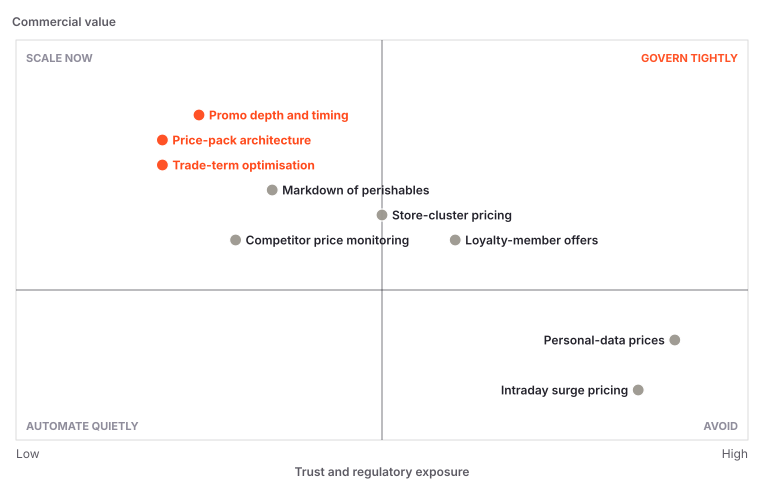
Read the matrix as a sequencing plan. Promotion optimisation, price-pack architecture and trade-term optimisation sit in the top left: high value, low exposure. Store-cluster pricing and loyalty-member offers carry value but need governance, because the line between a cluster and a person can blur. Intraday surge pricing and prices built from personal data sit bottom right: modest value in grocery, maximum risk to trust.
Why pricing governance is a commercial capability
Because trust is a pricing asset. Brand equity and price premium depend on shoppers believing the price is fair. One opaque experiment can cost more in perceived fairness than a year of optimisation earns. As we argued in The Override Gap, AI pays where the decision is redesigned around it. In pricing, that redesign must include the rules the model may not break.
The companies in AP's report that faced lawsuits or investigations, from Target's geofenced app prices to Instacart's price tests, each disputed the allegations or ended the practice. The lesson for consumer-goods leaders is not that AI pricing is dangerous. It is that every AI price needs an owner who can explain it to a shopper, a retailer and a regulator.
What to do now
- Write a pricing-data policy. State which data AI pricing may use (product, store, time, stock, competitor) and which it may not (individual identity, inferred income, location history). Owner: CCO with legal. Horizon: 30 days.
- Inventory every algorithm that touches price. Include retailer-side tools, retail media and D2C. Flag anything that uses personal data. Owner: head of RGM. Horizon: 60 days.
- Redirect AI investment to the top-left quadrant. Promotion depth and timing, price-pack architecture and trade terms. Owner: RGM director. Horizon: 90 days to first scaled use case.
- Build an explanation standard. For every AI-set price or promotion, be able to say in one sentence why it is what it is. Owner: pricing analytics lead. Horizon: 90 days.
- Align loyalty offers with the carve-outs. Make member pricing a transparent, opt-in discount, not a hidden personal price. Owner: CRM lead. Horizon: 90 days.
The bottom line
AI dynamic pricing will spread through consumer goods because the economics are compelling. The regulatory line is already visible: price the product, the pack, the promotion and the store, and leave the person out. Brands that draw that line themselves will keep both the margin and the trust. See how we approach this in our AI transformation framework.
Questions leaders ask
What is surveillance pricing?
Surveillance pricing is setting an individual's price from their personal data, such as purchase history, browsing or location. It differs from dynamic pricing, which changes the price for everyone.
Is dynamic pricing legal in Europe?
Yes. Product-level dynamic pricing is legal, but EU consumer law requires traders to disclose when a price has been personalised by automated decision-making, and further limits are under discussion in the Digital Fairness Act.
Do loyalty discounts count as personalised pricing?
Under New York's One Fair Price Act and the Maryland and New Jersey grocery rules, bona fide loyalty and promotional discounts are exempt. Transparent, opt-in member pricing is the safer design.